Categorias
Novo blog.
Quais são as Vantagens Exatas dos Ventiladores EC sobre os Motores AC Tradicionais em Sistemas HVAC?
August 28 , 2026O setor de HVAC está caminhando firmemente em direção a maior eficiência, controle mais inteligente, operação mais silenciosa e projetos de sistemas mais flexíveis. Entre as tecnologias que impulsionam essa mudança, destacam-se os ventiladores comutados eletronicamente, comumente chamados de ventiladores de comutação eletrônica.fãs da ECOs ventiladores de teto tornaram-se cada vez mais importantes em unidades de tratamento de ar, unidades de ventiloconvectores, sistemas de ventilação, equipamentos de refrigeração, bombas de calor, unidades de telhado e outras aplicações de movimentação de ar.
Durante décadas, os motores CA tradicionais, especialmente os motores de capacitor permanente e outros modelos de motores de indução, foram amplamente utilizados em equipamentos de climatização (HVAC) por serem relativamente simples, confiáveis, familiares aos fabricantes e fáceis de obter. No entanto, os sistemas de climatização modernos raramente operam com uma carga fixa o tempo todo. A demanda por aquecimento e refrigeração varia ao longo do dia, as temperaturas externas flutuam, a ocupação muda, os filtros ficam saturados e os sistemas de automação predial ajustam continuamente os requisitos de fluxo de ar.
É aqui que a tecnologia de ventiladores EC cria uma grande vantagem.
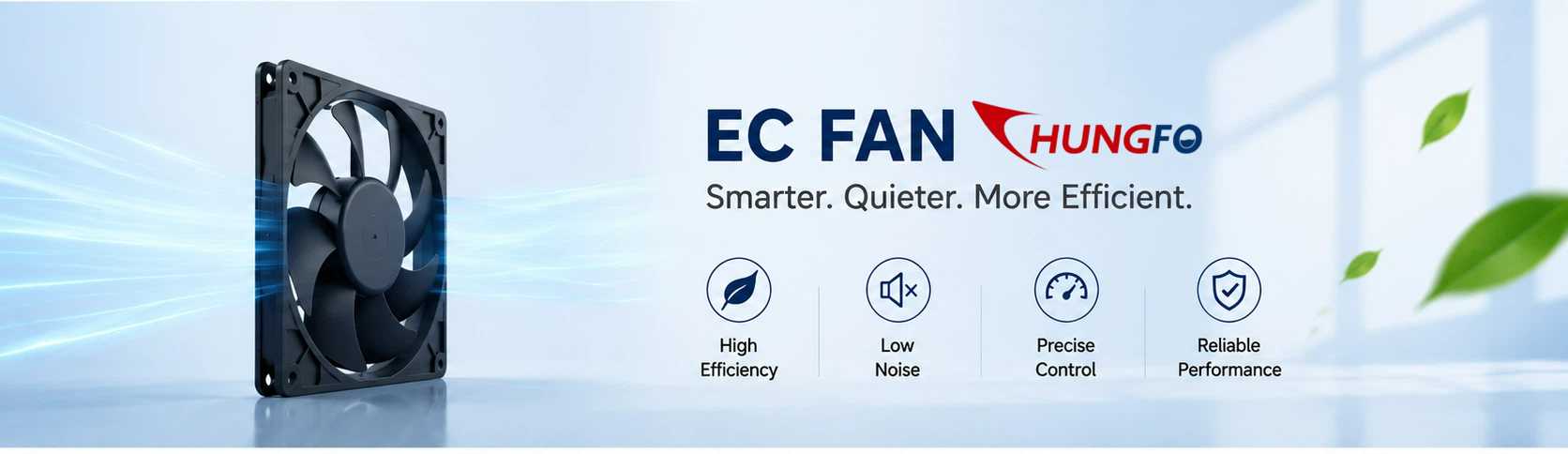
Um ventilador EC combina um motor comutado eletronicamente com controle eletrônico integrado. Embora normalmente possa ser conectado a uma fonte de alimentação CA, seu funcionamento interno utiliza comutação eletrônica e tecnologia de ímã permanente. Isso permite que o ventilador opere com eficiência em diferentes velocidades, recebendo sinais de controle precisos.
Segundo a ASHRAE, os motores comutados eletronicamente oferecem controle superior e podem responder a sinais de controle locais ou remotos, incluindo sinais de sistemas de gerenciamento predial. A ASHRAE também observa que os motores EC podem proporcionar economia de energia significativa em comparação com os motores PSC convencionais, principalmente em condições de carga parcial.
A verdadeira vantagem da tecnologia EC, portanto, não é simplesmente o fato de o motor consumir menos eletricidade em um determinado ponto de operação. A maior vantagem é que todo o sistema de ventilação pode responder às reais necessidades térmicas e de fluxo de ar do equipamento de climatização.
Entendendo a diferença entre ventiladores EC e motores AC tradicionais
Antes de comparar as vantagens, é importante entender o que realmente diferencia as duas tecnologias.
Um motor de indução CA tradicional ou um motor PSC recebe corrente alternada e cria um campo magnético rotativo que aciona o rotor. Suas características de operação são amplamente determinadas pela frequência da rede elétrica, construção do motor, carga e método de controle. Se for necessária operação em velocidade variável, equipamentos de controle adicionais, como um inversor de frequência, podem ser necessários para muitas configurações de motores CA.
Um motor PSC tradicional pode ser prático para equipamentos HVAC simples que requerem apenas operação básica de ligar e desligar ou um pequeno número de níveis de velocidade fixa. Ele tem sido amplamente utilizado em unidades de ventiloconvectores, condicionadores de ar, sistemas de ventilação e outros equipamentos.
Um motor EC, por outro lado, contém circuitos de comutação eletrônica e ímãs permanentes. O controlador eletrônico determina quando e como a corrente é aplicada aos enrolamentos do motor. Isso permite que a velocidade do motor seja ajustada eletronicamente, em vez de depender apenas das características da rede elétrica CA.
O resultado é um conjunto de motor e ventilador que pode operar em uma faixa de velocidade muito mais ampla.
Essa distinção torna-se especialmente importante em sistemas de climatização (HVAC), pois as necessidades de fluxo de ar raramente são constantes.
Um edifício pode exigir fluxo de ar máximo em uma tarde quente, quando a ocupação é alta, mas apenas uma fração desse fluxo de ar no início da manhã, à noite ou em clima ameno. Um sistema convencional de velocidade fixa pode continuar funcionando em alta velocidade e, em seguida, usar ciclos, dampers ou outros métodos para reduzir o fluxo de ar efetivo.
Um ventilador EC pode, em vez disso, reduzir sua velocidade diretamente.
Essa mudança aparentemente simples pode ter um efeito significativo no consumo total de energia.
Vantagem principal: Menor consumo de energia
O motivo mais importante pelo qual os fabricantes e engenheiros de sistemas HVAC consideram os ventiladores EC é a eficiência energética.
A potência do ventilador é fortemente afetada pela velocidade. Para muitos sistemas de ventiladores operando em condições comparáveis, a redução da velocidade do ventilador pode produzir uma redução desproporcionalmente grande na potência necessária no eixo. A ASHRAE explica que a potência no eixo do ventilador varia aproximadamente com o cubo da velocidade sob condições de lei de afinidade. Isso significa que uma redução relativamente pequena na velocidade pode resultar em uma redução muito maior na potência do ventilador.
Por exemplo, se um ventilador de um sistema de climatização puder reduzir sua velocidade para aproximadamente 80% da velocidade máxima, a potência teórica necessária para o ventilador pode cair para cerca de 51% do valor original, sob condições adequadas de lei de afinidade.
A uma velocidade de aproximadamente 70%, a necessidade teórica de energia pode cair para cerca de 34%.
A uma velocidade aproximada de 50%, pode cair para cerca de 13%.
Esses valores são teóricos e o desempenho real do sistema HVAC depende da curva de rotação do ventilador, da resistência do sistema, da eficiência do motor, do método de controle, dos requisitos de pressão e do ponto de operação. Ainda assim, eles demonstram por que a operação de ventiladores com velocidade variável pode ser tão eficiente.
Essa é uma das diferenças mais importantes entre um ventilador EC e um motor CA tradicional de velocidade fixa.
Um motor convencional pode ter que operar em uma velocidade relativamente alta e usar métodos mecânicos ou elétricos para restringir o fluxo de ar. Um ventilador EC pode reduzir diretamente a velocidade do motor, de modo que o ventilador produza apenas o fluxo de ar necessário para o sistema.
O resultado é menos desperdício de energia.
A ASHRAE destaca especificamente o excelente desempenho em cargas parciais dos motores EC como uma de suas principais vantagens. Em unidades terminais com ventilador, a ASHRAE relata que os motores EC podem consumir substancialmente menos energia do que os motores PSC com vazão de ar típica de projeto, podendo apresentar vantagens ainda maiores com vazão de ar reduzida.
Isso é importante porque os sistemas de climatização passam grande parte do tempo em funcionamento fora dos períodos de pico de demanda.
Um sistema projetado para o dia mais quente do ano não opera com demanda máxima de refrigeração a cada hora do ano. Portanto, avaliar a eficiência do motor apenas em plena carga pode fornecer uma visão incompleta do consumo anual de energia.
A pergunta mais pertinente não é simplesmente: "Qual motor tem a maior eficiência nominal?"
A pergunta mais pertinente seria: "Qual a eficiência de operação do ventilador ao longo de todo o perfil de carga anual?"
É aqui que a tecnologia EC se torna particularmente atraente.
Vantagem Exata Dois: Excelente Eficiência em Carga Parcial
A operação em carga parcial é um dos argumentos mais fortes para substituir os motores de ventilador CA convencionais pela tecnologia EC.
Os sistemas de climatização (HVAC) são frequentemente superdimensionados em relação à carga instantânea, pois os equipamentos precisam ser capazes de lidar com condições de pico. Pesquisas da ASHRAE sobre unidades de ventiloconvectores explicam que esses sistemas raramente operam em plena carga por períodos prolongados, tornando a modulação uma importante oportunidade para reduzir o consumo de energia.
Os motores tradicionais geralmente funcionam de forma eficiente dentro de uma faixa de operação mais estreita. Quando o fluxo de ar precisa ser reduzido, um sistema convencional pode ligar e desligar o motor intermitentemente ou usar um número limitado de configurações de velocidade.
Isso pode gerar consumo desnecessário de energia.
Um ventilador EC pode ajustar continuamente sua velocidade.
Suponha que uma unidade de ventiloconvector necessite de 100% do fluxo de ar durante um período de pico de refrigeração. Posteriormente, a carga térmica diminui e o sistema passa a necessitar de apenas 60% do fluxo de ar. Em vez de continuar a operar em velocidade máxima e desligar repetidamente, o ventilador EC pode reduzir a velocidade e manter um fluxo de ar mais baixo.
Isso melhora tanto a eficiência energética quanto o controle de temperatura.
Uma taxa de fluxo de ar mais baixa também pode reduzir a transferência de calor desnecessária e ajudar o sistema de climatização a operar mais próximo da demanda térmica real.
Pesquisas associadas à norma ASHRAE RP-1741 constataram que o controle de modulação pode reduzir significativamente o consumo de energia dos ventiladores em comparação com as estratégias de ciclagem convencionais, e simulações de energia em edifícios indicaram que a economia em sistemas de climatização pode ser substancial quando o fluxo de ar e o fluxo de água são ajustados de acordo com a carga.
Isto é particularmente relevante para edifícios comerciais modernos, onde as cargas de climatização (HVAC) estão em constante mudança.
Vantagem Exata Três: Controle de Fluxo de Ar Mais Preciso
O controle do fluxo de ar não é simplesmente uma questão de energia.
Afeta diretamente a temperatura, a umidade, a qualidade do ar interno, o equilíbrio da pressão e o conforto dos ocupantes.
Traditional AC motors may provide a simple high, medium, and low speed arrangement. This can work, but it limits the number of available operating points.
An EC fan can support much more precise speed control.
Depending on the model and control architecture, EC fans can accept analog or digital control signals and can be integrated with building automation systems. ASHRAE describes EC motors as devices that can respond to local or remote control signals and can support dynamic airflow control.
For example, a building management system can determine that a particular zone requires less cooling and send a lower speed command to the fan.
The fan responds immediately.
When the load increases, the speed can increase.
This creates a much closer relationship between actual building demand and fan output.
For modern HVAC equipment, that relationship is extremely valuable.
Exact Advantage Four: Better Compatibility With Smart HVAC Systems
Modern HVAC equipment is becoming increasingly connected.
Building automation systems can monitor temperature, humidity, pressure, occupancy, air quality, energy consumption, and other parameters. The HVAC system can then adjust operation according to those conditions.
An EC fan fits naturally into this architecture because the motor controller is already electronic.
Traditional AC motors can also be controlled electronically, but additional components may be required depending on the motor type and control strategy. This can increase system complexity.
An EC fan can integrate speed control directly into the fan motor assembly.
This creates a cleaner system architecture.
It can also reduce the amount of external control hardware required.
For HVAC manufacturers, this can simplify wiring and system integration.
For building operators, it can provide more flexible control.
For engineers, it can make it easier to develop demand-based airflow strategies.
The advantage becomes even more important when multiple fans are installed in a large HVAC system.
Instead of treating every fan as a simple fixed-speed device, the control system can coordinate fan speed with system demand.
Exact Advantage Five: Lower Noise During Reduced Load Operation
Noise is another major consideration in HVAC applications.
A fan operating at high speed generates more aerodynamic noise and motor-related noise than the same fan operating at a lower speed.
Traditional HVAC systems may need to operate a fan at a relatively high fixed speed and use cycling or other methods to manage demand.
An EC fan can reduce its speed when maximum airflow is unnecessary.
Lower speed generally means lower aerodynamic noise, although the exact noise reduction depends on fan geometry, air pressure, turbulence, mounting, duct design, bearings, and motor construction.
This is particularly useful in environments where acoustic comfort matters.
Examples include offices, hotels, hospitals, laboratories, residential buildings, classrooms, libraries, and commercial spaces.
A quieter HVAC system does not simply make the building more comfortable.
It can also improve the perceived quality of the HVAC equipment.
For manufacturers, this creates an opportunity to develop products that combine efficient airflow with low acoustic output.
Exact Advantage Six: Reduced Motor Heat
Motor efficiency is not only about electricity consumption.
Electrical losses become heat.
When a motor is less efficient, more of the input electrical energy is converted into unwanted heat. In HVAC equipment, that heat can become part of the thermal load that the system must manage.
ASHRAE notes that PSC motor inefficiency can manifest as motor heat added to the supply air. In some fan-powered terminal applications, this can increase the air temperature and reduce overall system efficiency.
EC motors can reduce this unwanted heat generation because of their higher efficiency and better part-load characteristics.
This is particularly useful in compact HVAC equipment where components are installed close together.
Lower internal heat can contribute to improved thermal conditions for nearby electronics and other components.
For compact air handling equipment, refrigeration systems, and integrated ventilation products, every reduction in unnecessary heat can be valuable.
Exact Advantage Seven: Compact And Integrated System Design
EC fans are often designed as integrated motor and fan assemblies.
The motor, controller, and impeller can be engineered as one system.
This is different from many traditional arrangements where the motor, control equipment, and fan are separate components.
An integrated EC design can reduce the need for external speed-control hardware and simplify installation.
It can also make the complete assembly more compact.
For equipment manufacturers, compactness can be important because modern HVAC products are often designed around strict dimensional requirements.
A smaller control footprint can create more room for heat exchangers, filters, insulation, electronics, or airflow passages.
This is especially valuable in packaged HVAC systems where internal space is limited.
Exact Advantage Eight: Easier Variable-Speed Retrofit Potential
Replacing an old AC motor is not always as simple as removing one motor and installing an EC fan.
The airflow requirement, static pressure, mounting dimensions, electrical supply, control signal, fan curve, and operating environment must all be considered.
However, EC technology can be attractive for retrofit projects because an integrated variable-speed fan can potentially replace a conventional fixed-speed fan assembly without requiring a completely new HVAC system.
The retrofit must be engineered carefully.
The replacement fan needs to deliver the required airflow and static pressure.
The electrical characteristics must be compatible with the equipment.
The control signal must be compatible with the existing controller or a suitable interface must be added.
The physical dimensions must fit the available installation space.
The result should be evaluated based on annual energy consumption rather than simply motor nameplate power.
This is particularly important because the greatest EC advantage often appears when the HVAC equipment spends significant time at part load.
Exact Advantage Nine: Better System Efficiency Than Simple Airflow Throttling
A common traditional strategy is to keep a fan running at a relatively high speed and then reduce effective airflow through dampers or other restrictions.
This approach can waste energy because the motor continues producing pressure that the system does not actually need.
EC technology takes a different approach.
Instead of forcing the fan to produce unnecessary pressure and then restricting the airflow, the control system can reduce the fan speed.
This allows the fan to operate closer to the required operating point.
The principle is simple.
Do not generate airflow that the building does not need.
Do not generate pressure that the system does not require.
Do not consume electrical power simply to overcome an unnecessary restriction.
The same philosophy can be applied to ventilation systems, air handling units, fan coil units, refrigeration equipment, and many other applications.
Exact Advantage Ten: Better Temperature And Humidity Management
HVAC control is not only about reaching a temperature setpoint.
Humidity and thermal stability are also important.
A fixed-speed fan can create larger changes between full-load operation and off periods. An EC fan with appropriate control can operate at a lower continuous airflow when the load is reduced.
This can help maintain a more stable indoor environment.
ASHRAE describes fully modulating EC fan coil systems as capable of varying fan speed according to control signals, with potential benefits for temperature and humidity stability as well as energy consumption.
This does not mean that every EC fan automatically provides perfect humidity control.
System design still matters.
The fan, coil, valve, controller, sensor, duct system, and building load must work together.
However, the EC motor provides the control capability required for much more sophisticated HVAC operation.
Why An EC Fan Can Be Better For Modern Air Handling Units
Air handling units often experience continuously changing operating conditions.
Outdoor air requirements change.
Filter pressure changes.
Building occupancy changes.
Cooling and heating loads change.
Static pressure changes.
A traditional fixed-speed AC motor can operate reliably under these conditions, but it does not inherently respond intelligently to them.
An EC fan can.
A controller can increase speed when airflow demand rises and reduce speed when demand falls.
The result is a fan system that behaves more like an active component of the HVAC control strategy rather than a simple motor that is switched on and off.
This distinction is increasingly important as commercial buildings become more automated.
Why EC Technology Is Valuable In Fan Coil Units
Fan coil units are another important application.
Traditional fan coil units often use three-speed motors.
The user or thermostat selects low, medium, or high speed.
This arrangement is simple, but the system only has a limited number of operating points.
Modern EC fan coil units can provide multiple speed levels or continuous modulation.
ASHRAE identifies EC motors as an increasingly common option for fan coil units and notes their advantages in energy efficiency, controllability, operating range, and comfort.
For hotels and offices, this can be particularly useful because room loads can vary significantly.
For example, a hotel room may have very different cooling requirements when occupied compared with when it is empty.
A variable-speed EC fan can respond to this difference.
The system does not have to operate as though the room is always at peak load.
EC Fans In Ventilation And Exhaust Applications
EC technology is not limited to cooling systems.
It can also be applied to ventilation, exhaust, air circulation, and fresh-air systems.
A ventilation system may need maximum airflow during occupied periods and reduced airflow at other times.
With an EC fan, the system can adjust airflow based on demand.
This can be useful in commercial buildings, industrial facilities, laboratories, kitchens, parking areas, and other ventilation environments.
The exact fan type depends on the required airflow and pressure.
For applications requiring direct airflow through a relatively open path, an Axial Fan can be an effective choice.
For applications requiring higher pressure or airflow through filters, coils, ducts, and compact passages, a centrifugal fan or blower may be more appropriate.
The key point is that EC motor technology can be integrated with different fan geometries.
This means engineers should not think of EC technology as a single fan shape.
It is a motor and control architecture that can be combined with the fan design required by the application.
EC Technology For Compact HVAC And Electronic Cooling
The demand for smaller HVAC and thermal management systems is also increasing.
Compact equipment requires smaller motors and fans that can deliver stable airflow without consuming excessive energy.
In these applications, anac dc small fanmay provide a useful solution when compact size, electrical flexibility, and controlled airflow are important.
Small EC or electronically controlled fan assemblies can be used in compact ventilation systems, control cabinets, refrigeration equipment, heat pump electronics, communication equipment, and other thermal management systems.
The same engineering principle remains important.
The fan should be selected according to airflow, static pressure, voltage, speed, noise, operating temperature, expected lifetime, and control requirements.
A small fan that consumes little electricity but cannot overcome the system resistance is not an efficient solution.
Fan performance must always be evaluated at the actual operating point.
EC Fans And Specialized Cooling Applications
Modern product development also creates demand for customized cooling components.
For example, rapid prototyping and customized equipment development can involve3d print cooling fansolutions where airflow is needed to control temperatures around printed parts, electronic modules, motors, or compact equipment.
Although the exact fan selection depends on the application, EC fan technology can provide advantages when the cooling requirement changes during operation.
The ability to adjust speed allows designers to avoid using maximum airflow continuously.
This can reduce noise and energy consumption while maintaining the required thermal conditions.
The same concept can be extended beyond additive manufacturing to laboratory equipment, automation systems, robotics, battery systems, and electronic enclosures.
EC Fan Selection: What Engineers Should Actually Compare
It is easy to compare an EC fan and an AC motor based only on motor efficiency.
That is not enough.
A professional comparison should include the complete fan system.
The first parameter is airflow.
How much air must the fan move?
The second parameter is static pressure.
What resistance must the fan overcome?
The third parameter is operating time.
How many hours per year will the fan operate?
The fourth parameter is load profile.
Will the fan operate continuously at full speed, or will it spend much of its time at partial load?
The fifth parameter is control method.
Does the system require on and off operation, three fixed speeds, or continuous variable-speed control?
The sixth parameter is acoustic performance.
Is the HVAC equipment installed in a residential, office, hospital, hotel, laboratory, or industrial environment?
The seventh parameter is electrical compatibility.
What voltage and control signals are available?
The eighth parameter is environmental performance.
Will the fan operate in high humidity, high temperature, dusty environments, or other demanding conditions?
The ninth parameter is mechanical compatibility.
Does the fan fit the existing mounting arrangement?
The tenth parameter is lifecycle cost.
The cheapest motor at purchase may not be the cheapest solution over ten years.
Purchase Price Versus Total Cost Of Ownership
One reason traditional AC motors remain popular is initial cost.
They are familiar products with established supply chains.
EC fan assemblies may have a higher initial purchase price because they include electronic controls and more sophisticated motor technology.
However, purchase price is only one part of the economic equation.
HVAC equipment may operate thousands of hours per year.
Even a modest reduction in power consumption can accumulate into significant annual savings.
If the fan operates continuously, the difference becomes even more important.
This is why EC fan selection should be based on lifecycle economics.
Engineers should compare annual kilowatt-hours, expected operating hours, maintenance requirements, replacement costs, and control requirements.
A higher initial investment can make sense when the annual operating savings and system benefits are sufficiently large.
When Traditional AC Motors May Still Make Sense
EC technology has many advantages, but it does not mean that traditional AC motors are always wrong.
A simple AC motor may still be suitable for applications with very low operating hours, simple on and off control, limited speed requirements, strict initial-cost targets, or existing infrastructure designed specifically around conventional motors.
For some large industrial systems, a conventional motor combined with a properly selected variable frequency drive can also provide excellent efficiency and speed control.
The decision should therefore be based on the actual application rather than technology preference alone.
A good engineering decision compares the complete system.
EC Versus AC: The Most Important Practical Difference
If the comparison has to be reduced to one sentence, the biggest difference is this:
A traditional AC motor is often treated primarily as a power source for the fan, while an EC fan can function as an integrated airflow control system.
That difference affects almost everything else.
Because the EC fan can vary speed, it can reduce energy consumption.
Because it can respond to control signals, it can improve airflow regulation.
Because it can operate at lower speeds, it can reduce noise.
Because its controller is integrated, it can simplify system architecture.
Because it can match output to load, it can improve part-load performance.
Because it can communicate with modern control systems, it can support smart HVAC applications.
This is why EC technology has become increasingly relevant to modern HVAC engineering.
The Role Of Fan Manufacturers In EC HVAC Development
Choosing the right motor technology is only part of the process.
The fan itself must also be designed correctly.
An efficient motor connected to an inefficient impeller will not automatically create an efficient HVAC system.
The impeller geometry, housing design, airflow path, motor characteristics, bearing system, balancing accuracy, vibration performance, acoustic design, and control algorithm all influence the final result.
For this reason, experienced fan manufacturers need to evaluate the complete fan assembly.
Chungfo Fan focuses on fan and motor technologies for different thermal management and air movement applications. For HVAC-related products, the engineering process should begin with the actual application requirements rather than simply selecting a motor from a catalog.
The required airflow, static pressure, voltage, speed, noise level, installation dimensions, control method, operating temperature, and expected service life should all be considered.
A properly selected fan can help HVAC manufacturers achieve a better balance between efficiency, acoustic performance, reliability, and system cost.

Why EC Fans Are Becoming A Strategic HVAC Choice
The HVAC industry is changing from simple fixed-speed operation toward intelligent load matching.
Buildings are becoming more automated.
Energy efficiency requirements are becoming more demanding.
Occupants expect better acoustic comfort.
Equipment is becoming more compact.
Maintenance and lifecycle costs are receiving more attention.
These trends all favor technologies that can adapt to changing conditions.
EC fans fit this direction very well.
They are not simply a replacement for a traditional AC motor.
They represent a different approach to fan system design.
Instead of generating a fixed amount of airflow and controlling the result through cycling or restriction, an EC fan can adjust its output directly.
This is a fundamental reason why EC technology can provide strong advantages in modern HVAC systems.
Final Conclusion
The exact advantages of EC fans over traditional AC motors in HVAC systems can be summarized through several connected benefits.
EC fans can provide higher efficiency, especially during part-load operation. They can provide continuous or flexible speed control, respond to temperature and airflow requirements, reduce unnecessary fan power, lower operating noise at reduced speed, reduce motor heat, simplify electronic integration, and support modern building automation systems.
The most important point is that these advantages are not independent.
Variable-speed control makes part-load efficiency possible.
Part-load efficiency reduces energy consumption.
Lower speed can reduce noise.
Integrated electronic control improves system responsiveness.
Better airflow control can improve comfort.
Lower motor losses can reduce unwanted heat.
Together, these characteristics can make an EC fan a more complete solution for modern HVAC equipment.
However, EC technology should always be selected according to the actual duty point. Engineers should compare airflow, static pressure, speed range, efficiency, control compatibility, acoustic performance, operating hours, environmental conditions, installation dimensions, and total lifecycle cost.
For new HVAC designs, EC fans are especially attractive when variable airflow and long operating hours are expected.
For retrofit projects, they can also provide an opportunity to improve the efficiency and controllability of existing equipment, provided that the replacement is correctly matched to the original system.
As HVAC systems continue to become more intelligent and energy conscious, the value of an efficient, controllable, and integrated fan will continue to increase.
For manufacturers and system designers, the question is therefore no longer simply whether an EC fan can replace a traditional AC motor.
The more important question is whether the HVAC system can benefit from continuously matching fan output to actual demand.
In many modern HVAC applications, that is exactly where EC fan technology provides its greatest advantage.
FAQ
What is the main advantage of an EC fan over a traditional AC motor?
The main advantage is the combination of high efficiency and variable-speed control. An EC fan can adjust airflow according to actual HVAC demand instead of operating only at fixed speed or relying heavily on cycling and airflow restriction.
Are EC fans more energy efficient than traditional AC motors?
Em muitas aplicações de HVAC, sim, especialmente quando o sistema opera com carga parcial por períodos significativos. A economia exata depende do ventilador, do motor, do ponto de operação, da pressão estática, da estratégia de controle e do perfil operacional anual. A ASHRAE identifica a alta eficiência em carga parcial e a controlabilidade como importantes vantagens dos motores EC.
Um ventilador EC pode operar em velocidade variável?
Sim. A operação em velocidade variável é uma das características mais importantes da tecnologia de ventiladores EC. Dependendo do projeto, o ventilador pode receber sinais de controle analógicos, digitais ou de outra natureza e ajustar a velocidade para atender às necessidades de fluxo de ar.
Os ventiladores EC são adequados para unidades de tratamento de ar?
Sim. Os ventiladores EC podem ser usados em unidades de tratamento de ar onde o fluxo de ar variável, a eficiência energética, o baixo ruído e o controle inteligente são importantes. Eles também podem ser integrados a estratégias de gestão predial.
Os ventiladores EC podem substituir os motores CA tradicionais em sistemas HVAC existentes?
Potencialmente, sim, mas a substituição não deve ser baseada apenas nas dimensões do motor. Fluxo de ar, pressão estática, voltagem, sinais de controle, dimensões de montagem, curva de rotação do ventilador, temperatura de operação, ruído e compatibilidade com o sistema devem ser verificados antes da substituição.
Os ventiladores EC são mais silenciosos do que os ventiladores tradicionais com motor AC?
Eles podem ser mais silenciosos durante a operação em velocidade reduzida, pois uma velocidade menor do ventilador geralmente reduz o ruído aerodinâmico. No entanto, o desempenho real em termos de ruído depende do projeto completo do ventilador, do fluxo de ar, da pressão, da geometria do impulsor, da montagem, do sistema de dutos e do ponto de operação.
Os ventiladores EC são mais caros do que os motores AC tradicionais?
O preço de compra inicial pode ser mais elevado, pois um conjunto EC inclui tecnologia de controle eletrônico. No entanto, o custo total de propriedade pode ser menor quando o ventilador opera por longos períodos e se beneficia da economia de energia proporcionada pela velocidade variável.
Como os engenheiros devem escolher um ventilador EC para equipamentos de HVAC?
Primeiramente, os engenheiros devem determinar a vazão de ar e a pressão estática necessárias. Em seguida, devem avaliar a faixa de velocidade, os requisitos elétricos, o ruído, a temperatura de operação, as dimensões, a interface de controle, a confiabilidade, a eficiência e as condições operacionais anuais. Comparar ventiladores apenas pela vazão de ar máxima ou pela potência nominal do motor pode levar a uma seleção incorreta.
Por que os ventiladores EC estão se tornando mais comuns em sistemas de climatização modernos?
Os sistemas modernos de climatização (HVAC) exigem cada vez mais fluxo de ar variável, eficiência energética, controle preciso, baixo ruído e compatibilidade com automação predial. A tecnologia EC combina essas características em uma solução integrada de ventilador e motor, tornando-a particularmente adequada para aplicações modernas de climatização.